What it is, how it works, and why marketing doesn't have to feel like something that happens to you.
Let me start with the truth most marketing conversations skip.
There is no witchcraft. There is no set-it-and-forget-it. There is no single right answer that works for every business in every market at every moment. Marketing is hard. All the time. It changes constantly. It doesn't exist in a bubble. And anyone who tells you otherwise is either selling something or hasn't been close enough to the real thing.
What there is — what actually exists and actually works — is a system. A way of reading what's happening, understanding where the leverage is, making decisions based on signal rather than gut, and adjusting course while there's still time to change the outcome.
That's what Field → Funnel™ is.
Not a campaign. Not a channel strategy. Not a set of tactics dressed up as a framework. A growth operating system — built for operators who want some control over what happens to their business instead of just waiting to see what the market does to them.
Why Most Marketing Feels Broken
Marketing doesn't fail because operators aren't trying hard enough or spending enough money.
It fails because it's disconnected.
Brand, content, and performance running in separate lanes. Decisions made on feel because the right numbers aren't visible. Agencies optimizing for their metrics while the owner wonders why revenue isn't following. A sales team closing appointments with no connection to what marketing is saying. Spend going up while clarity goes down.
The problem isn't any one of those things. It's that nobody connected them into a system.
When the pieces don't talk to each other the whole thing leaks. And the standard response — more spend, more channels, more activity — just moves more volume through the same leaks at higher cost.
Field → Funnel™ connects the pieces.
The Field: Reality First
Everything starts here.
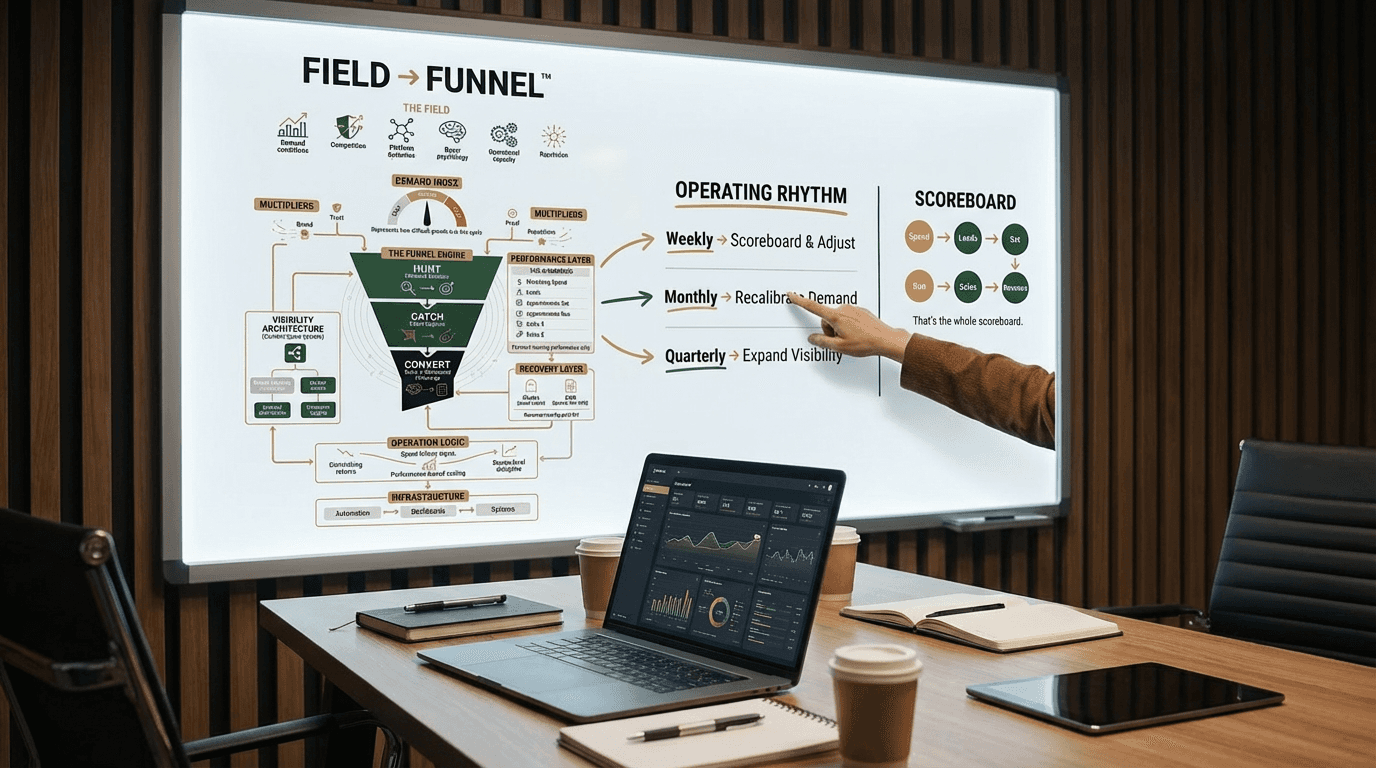
The Field is market reality — everything outside your business that shapes how hard or easy growth is right now. Demand conditions. Competition. Seasonality. Platform shifts. Buyer psychology. Your reputation in the market. The economy your customers are living in.
The Field is not your plan. It is not your forecast. It does not care about your quarterly goals.
We do not argue with the Field. We adapt to it.
This is the principle that separates operators who read the market from operators who react to it. You can't outspend market conditions. You can't run enough ads to overcome a reputation problem or a demand cycle that's shifted. But you can learn to read what's actually happening — and make decisions that fit the reality you're in rather than the one you wish you were in.
The Demand Index is how we measure this — a read on whether growth is Easy, Normal, or Hard in your current cycle. It changes. Your strategy should change with it.
The Funnel: The Revenue Engine
The Funnel is the internal system that moves someone from first awareness of your business all the way to closed revenue — and back again through reputation.
It doesn't start at the lead. It starts the moment someone encounters your brand for the first time. And it doesn't end at the sale. Every job delivered either builds or erodes the reputation that shapes how hard or easy the next cycle is.
Inside the Funnel there are three active stages:
Hunt is demand creation — where education and awareness live. The job of a Hunt tactic is to create demand, not capture it. Brand awareness, content, educational blog posts, social content that teaches something — these are Hunt. They plant seeds with people who aren't ready yet and build the familiarity that makes everything downstream easier and cheaper. Hunt is hard to attribute cleanly which is exactly why it gets underfunded. Owners pour budget into Catch because leads are traceable. But Hunt is what fills the pipeline that Catch depends on. Stop planting seeds and eventually there's nothing left to catch. The question that categorizes any tactic: is this creating demand or capturing it? If it's creating — it's Hunt.
Catch is intent capture — the mechanisms that capture demand that already exists. The job of a Catch tactic is to be there when someone is ready to raise their hand. Google search ads, LSA, GMB, lead gen forms — these are Catch. The person is already looking. Your job is to be findable, frictionless, and fast. Note that the channel doesn't determine the category — the job does. A Facebook awareness ad is Hunt. A Facebook lead gen ad is Catch. Same platform, different job. Catch covers the full journey from lead arrival to qualified booked appointment — four distinct things all live here: speed-to-lead, lead to appointment conversion (who is answering and how well they're handling the booking conversation), booking and confirmation process, and no-show management. Each one is a separate potential leak. A fast response that lands with an unprepared person still loses the booking. A great conversation that never gets confirmed still produces a no-show. All four have to work. This is the most expensive leak in most funnels because it's the least visible and the least reported.
Convert is everything from booked appointment to closed revenue. The appointment runs. The salesperson shows up. The estimate is delivered. The job is sold — or it isn't. Convert is where marketing messaging gets validated or contradicted by a real human conversation. The salesperson is the only person in your entire system who actually talks to the prospect. Their intelligence should be flowing back into how you Hunt. The loop runs both directions.
The Numbers: Where to Look, Not What to Think
There are six numbers that tell you how your growth engine is actually performing.
Marketing Spend. Leads. Appointments Set. Appointments Run. Sales Count. Revenue.
From those six, you can derive everything that matters — set rate, show rate, close rate, cost per lead, cost per sale, ROI. Every meaningful metric flows from the same six inputs tracked consistently.
These numbers are not new. They're basic. The difference is tracking all six, together, in relationship to each other, every week.
Here's what I want to be clear about: the numbers don't give you the answers. They show you where to look. They're vitals — not a historical report on what already happened, but a real-time read on what's happening now while there's still time to intervene. A close rate that drops tells you something changed in Convert. A set rate that falls tells you something broke in Catch. The numbers point. You still have to diagnose and decide.
That's the art and science of this. The science gives you signal. The art is knowing what to do with it.
And because attribution is always messy — a customer rarely comes from one source cleanly — you use these numbers directionally. Patterns and trends over time. Navigation, not accounting.
Recovery: The Revenue You Already Paid For
Most businesses try to grow by generating more demand. Smart operators also grow by recovering what they already paid for.
Two pools only.
Ghosts — leads that had contact with your business, showed intent, and then went cold. They ghosted you. The pile never fully empties and you work it continuously — because some percentage will come back around when the timing is right for them. Not a one-time cleanup. An ongoing recovery layer.
DNS — Demo No Sale. Appointments that ran, estimates delivered in the home, jobs that didn't close. You paid to generate that lead. You paid to run that appointment. A salesperson was in that home. The acquisition cost is already spent. A structured recovery system on these two pools is one of the highest-ROI activities available to any service business.
Recovery doesn't replace new demand. It maximizes the return on demand you've already created.
Multipliers: Make It Cheaper Over Time
Brand equity. Reputation. Trust. Evergreen content.
These are multipliers — assets that make marketing more effective over time without requiring proportional spend increases. A business with strong multipliers converts leads at higher rates, closes at better margins, and gets more from every marketing dollar than a comparable business without them.
Brand is not decoration. It's a financial asset. Every job delivered well, every review earned, every piece of content that educates a future customer — these compound. They lower your future cost of acquisition. They make the Funnel work harder for the same spend.
This is the long game inside the system. You build it while you're running everything else.
Operating Rhythm: How the System Stays Alive
A system without rhythm degrades.
The Operating Rhythm is the cadence that keeps Field → Funnel™ from becoming a one-time exercise. Weekly scoreboard review — look at the six numbers, diagnose what moved, adjust what needs adjusting. Monthly demand recalibration — read the Field again, reassess conditions, realign strategy. Quarterly visibility and planning reset — step back, look at the fuller picture, build what the next cycle requires.
This is what separates businesses that make consistent progress from businesses that lurch between reactions. It's also the answer to the most common failure mode in marketing — the annual plan that gets set in January and never looked at again.
Growth isn't a planning event. It's an ongoing decision-making practice.
What This Makes Possible
When the system is running — Field being read, Funnel being managed, numbers being tracked, recovery being worked, multipliers being built, rhythm being kept — something shifts in how it feels to run the business.
You stop waiting to see what happens to you. You start having some say in what happens next.
Not control. Marketing doesn't offer control. The Field will always have conditions you didn't plan for, platforms that shift, seasons that surprise you. But informed decisions made in rhythm beat reactive decisions made in panic. Every time.
You can forecast. You can set a revenue target, back-calculate the leads and appointments, and spend required to hit it, and know in real time whether you're on track or whether something needs to change. That's not a wish. That's math made visible.
The goal of Field → Funnel™ is not a perfect system. It's a system that learns — one that gets smarter as you feed it information, adjusts based on what it tells you, and builds the multipliers that make the next cycle easier than the last one.
Where to Go From Here
If you're reading this and recognizing your business in some of what I've described — the reactive decisions, the reports that don't connect to revenue, the feeling that marketing is something happening to you rather than something you're running — the next step is a Scorecard Session.
Sixty minutes. We look at your numbers together. We identify where the system has friction. We build a Fix-First plan — not a proposal for more spend, a sequence for where to put your attention first.
That's where this starts.
→ Book a Scorecard Session
Lynne Wilson is the founder of Field → Funnel™ — a growth operating system for multi-location operators and franchise businesses. This is the system. Everything else on this site goes deeper into the pieces.